
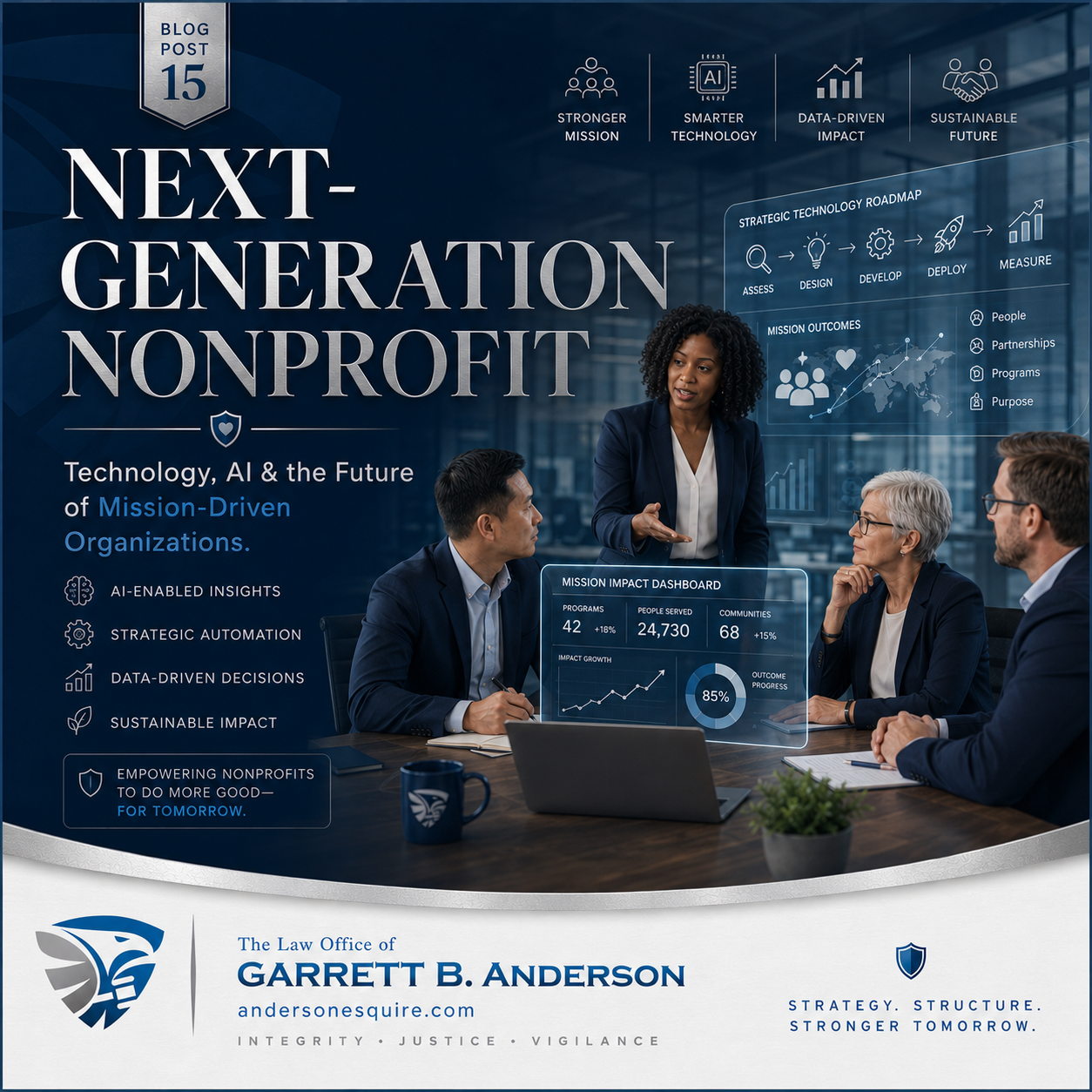
Building the Next-Generation Nonprofit: Technology, AI, and the Future of Mission-Driven Organizations
A Sector at an Inflection Point
The nonprofit sector is experiencing a convergence of pressures that is reshaping what organizational excellence requires. Donor expectations around digital engagement, transparency, and impact reporting have evolved significantly. Government funders are integrating data-driven accountability frameworks into grant requirements. AI tools are beginning to alter how organizations conduct research, draft communications, manage compliance calendars, and analyze program outcomes.
Organizations that engage these shifts strategically will be better resourced, more competitive, and more effective. Those that treat them as distractions from "the real work" will find themselves increasingly outpaced by peers who understand that operational excellence and mission fidelity are not in tension.
Technology as a Governance Tool
Modern nonprofit governance is supported, and in some respects required, by technology infrastructure. Board management platforms enable secure document sharing, electronic voting, minutes management, and policy tracking. Donor management systems provide the relationship history and communication records that sustain major gift cultivation. Grant management software tracks application deadlines, reporting obligations, and funder relationships across multiple funding streams simultaneously.
These are not luxuries for large organizations. They are operational necessities for any organization serious about governance quality and institutional credibility. The question is not whether to invest in technology infrastructure, but which investments deliver the highest return on organizational capacity.
Artificial Intelligence: Practical Applications for Nonprofits
AI tools are moving from novelty to operational utility at a pace that exceeds most sector conversations about them. Practically, AI is already delivering value to nonprofits in several areas:
Grant research and prospecting, where AI-assisted tools can identify foundation priorities, map funder landscapes, and analyze 990-PF data to surface alignment between organizational programs and funder interests with a speed and scale no development staff team can replicate manually.
Document drafting and policy development, where language models can produce first drafts of board policies, grant narratives, compliance checklists, and donor communications that staff then refine and personalize, compressing production timelines significantly.
Outcome data analysis, where AI tools can assist in identifying patterns across program data, surfacing insights that inform program design and strengthen impact reporting.
The Governance Obligation Around AI
AI adoption in the nonprofit sector is not without risk, and those risks are governance obligations, not just operational concerns. Organizations using AI tools must consider data privacy and confidentiality, particularly when AI platforms process donor information, client records, or personnel data. They must establish policies governing staff use of AI in program delivery and communications. And they must exercise discernment about the quality and accuracy of AI-generated content, which requires human review and institutional judgment before use.
Boards of forward-thinking organizations are beginning to adopt AI governance policies as part of their broader technology governance frameworks. This is not overreach. It is fiduciary responsibility applied to a consequential operational domain.
The Equity Dimension
A serious conversation about technology and the nonprofit sector's future must include the equity dimension. Community-based organizations with limited budgets, lean staff, and limited board technical expertise face real barriers to technology adoption that their larger, better-resourced counterparts do not. Funders who care about sector health have a role to play in supporting technology infrastructure grants, not just program funding, that enable smaller organizations to build competitive operational capacity.
Organizations that can make the case for capacity investment, including technology infrastructure, as mission-critical rather than overhead, are better positioned to secure that support.
Positioning for the Next Decade
The next-generation nonprofit is not defined by its size. It is defined by the clarity of its mission, the strength of its governance, the sophistication of its institutional relationships, and its willingness to build the operational infrastructure that sustains long-term community impact. Technology and AI are tools in that construction, not the construction itself.
Organizations that have read this series from the first post to this one have encountered a coherent argument: that mission matters, that structure protects mission, that governance and development and compliance and strategy are not separate disciplines but interconnected dimensions of a single organizational commitment to excellence.
That commitment is what separates organizations that endure from those that simply existed.
Practical Takeaways
Conduct a technology audit of your current platforms: donor management, financial management, board governance, and communications. Identify the gaps.
Develop a written AI use policy before staff use becomes ad hoc and unmanaged.
Explore grant opportunities specifically designated for nonprofit technology infrastructure and capacity building.
Include technology literacy as a criterion in board recruitment and staff professional development planning.
Engage legal counsel to review any AI platform terms of service before processing donor, client, or personnel data through those systems.
The organizations built to serve the next generation of communities are not waiting to see how things develop. They are developing them.
Interested in strengthening your organization's governance, grant readiness, or operational capacity? Contact our office to learn more about nonprofit consulting and institutional development services.
