
Board Training: The Most Overlooked Investment in Nonprofit Success
The Expectation Gap
Most nonprofit board members accept their appointments with genuine enthusiasm and limited orientation. They understand, in general terms, that they are there to "support the organization." What many do not understand, until a crisis requires them to, is the precise nature of their fiduciary duties, their personal liability exposure, their role in executive oversight, and the specific governance practices their organization has adopted.
That gap between expectation and understanding is not a character failure. It is a systemic training failure, and the organization bears responsibility for it.
Three Fiduciary Duties Every Board Member Must Understand
Board members of nonprofit corporations owe three fundamental duties under state law and charitable trust doctrine:
The Duty of Care requires board members to act with the diligence, attention, and skill that a reasonably prudent person would apply in similar circumstances. This means reading the materials, asking informed questions, and not simply deferring to staff on every decision.
The Duty of Loyalty requires board members to act in the best interest of the organization, not their personal interests or those of another entity they represent. This is the foundation of conflict-of-interest policy.
The Duty of Obedience requires board members to ensure the organization remains faithful to its stated mission and complies with applicable law. It prohibits the board from redirecting organizational resources in ways inconsistent with the charitable purpose.
These duties are not aspirational. They are legal standards, and board members can face personal liability for material breaches.
What Effective Board Training Covers
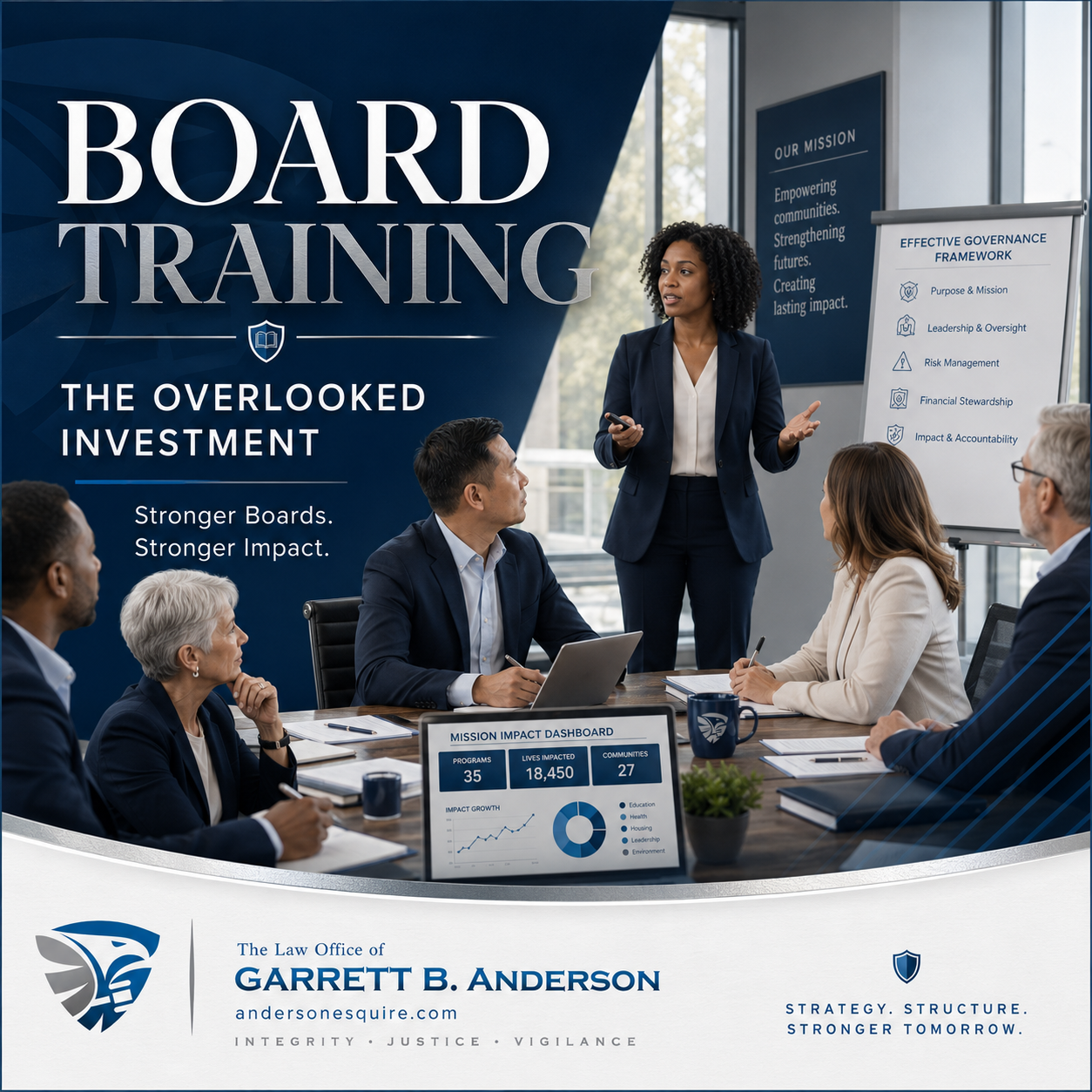
A robust board training program addresses governance roles and responsibilities, financial oversight and literacy, legal and regulatory compliance, conflict-of-interest policy implementation, executive oversight and performance evaluation, strategic planning participation, and fundraising expectations.
This training should occur at onboarding and be reinforced annually, with updates when law, policy, or organizational structure changes.
The ROI of Governance Training
Organizations that invest in board training report stronger engagement, more substantive board participation in strategic decisions, fewer governance disputes, and more confident leadership in donor and funder conversations. Board members who understand their role are more willing to fulfill it, including the parts that require uncomfortable candor.
Practical Takeaways
Develop a formal board orientation packet that includes bylaws, financial overview, strategic plan, and governance policies.
Host an annual board governance review session, not a retreat focused on relationship building, but a working session on governance quality.
Bring in outside counsel or a governance consultant periodically to present on fiduciary duties, sector trends, and organizational risk.
Survey board members annually on training needs and engagement quality.
The board is the organization's highest governance authority. Training that authority is not optional.
Interested in strengthening your organization's governance, grant readiness, or operational capacity? Contact our office to learn more about nonprofit consulting and institutional development services.
