
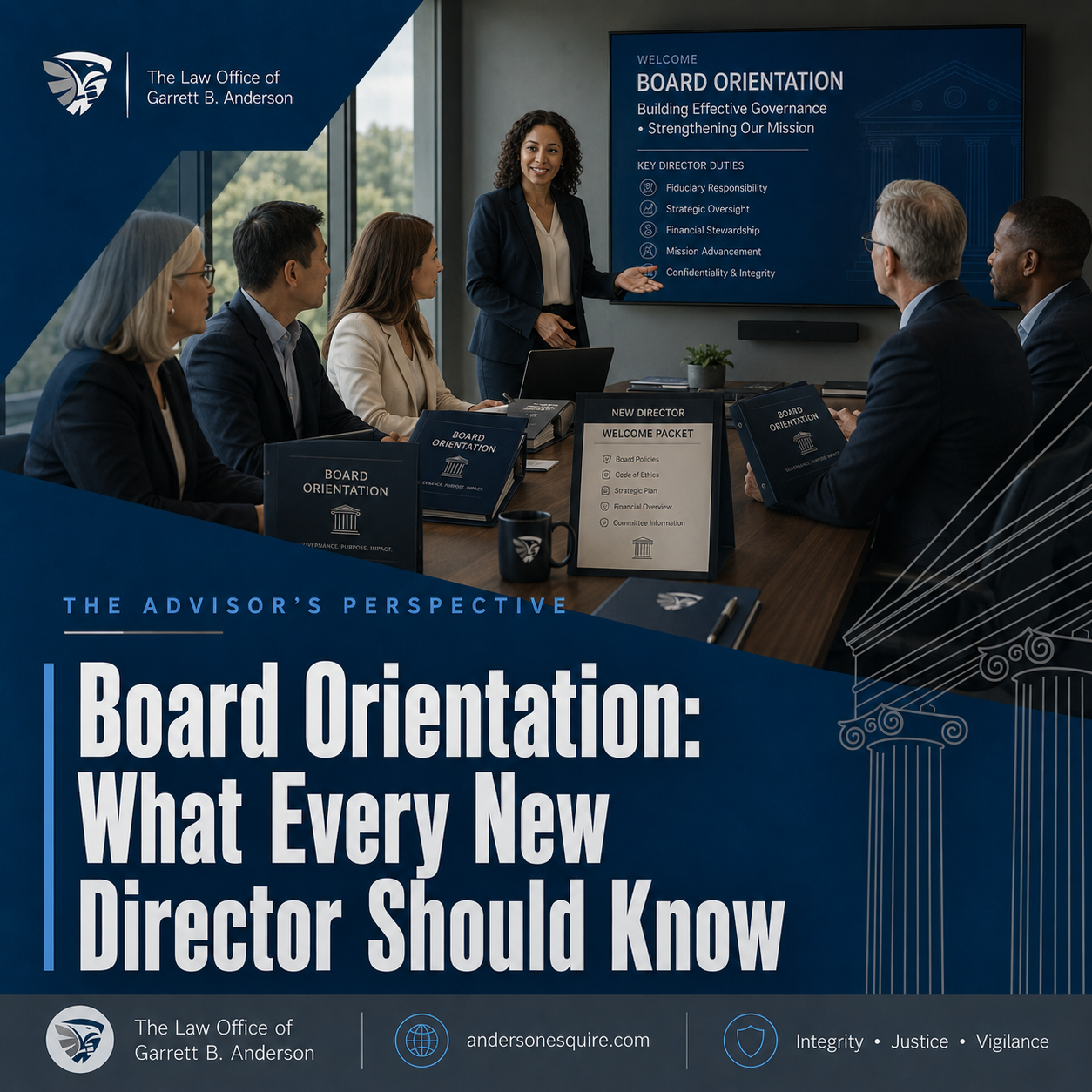
Joining a nonprofit board is often framed as an act of generosity or community commitment, which it is. What it also is, though rarely communicated as clearly, is the acceptance of real legal responsibilities. New directors who are not oriented properly to those responsibilities are more likely to create governance problems, even with the best of intentions.
At a minimum, board orientation should cover the organization's mission, governing documents, financial condition, and current strategic priorities. But it should also include a clear explanation of fiduciary duties. Directors owe the organization a duty of care, which means making informed decisions based on reasonable inquiry. They owe a duty of loyalty, which means acting in the organization's interest rather than their own or a third party's. And they owe a duty of obedience to the organization's mission and governing documents.
New directors should also understand the organization's conflict of interest policy and sign an annual disclosure statement. They should know who has authority to sign contracts, what financial controls are in place, and how decisions are documented. These are not administrative details. They are the functional elements of responsible board service.
Organizations that fail to orient new board members properly often discover the gap when something goes wrong. A director who was never told about the conflict of interest policy, or who never understood that board minutes have legal significance, is not fully equipped to serve the organization well.
Practical Takeaways
• Board orientation should include fiduciary duties, not just an introduction to the mission and programs.
• New directors should receive and review governing documents, financial statements, and key policies before their first vote.
• The duty of care, duty of loyalty, and duty of obedience are the legal foundation of board service.
• Conflict of interest disclosure, signing authority, and financial controls should be part of every onboarding.
• A well-oriented board member is a more effective and legally protected board member.
Organizations grow stronger when legal structure, governance, and strategy work together. The Law Office of Garrett B. Anderson assists mission-driven organizations, nonprofits, churches, and leaders with counsel designed to support sound decisions and sustainable growth.
If your organization needs a board orientation framework or governance training, we welcome the conversation.
Disclaimer: This post is for informational purposes only and does not constitute legal advice. For guidance specific to your organization, consult qualified legal counsel.
